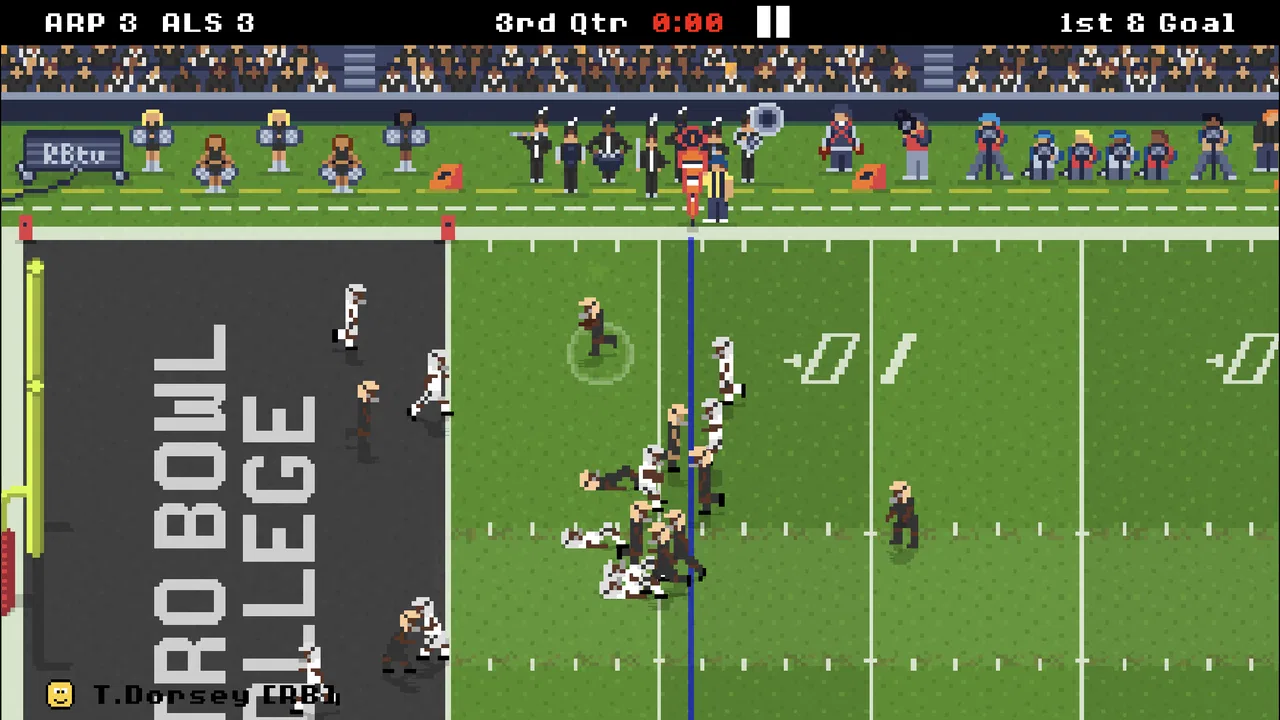
Retro Bowl College
- 4.9
- Rating
- 1.00M
- Installs
- Free
- Price

 Analysis by App-foxy
I approached Retro Bowl College expecting a quick sports game with a deliberately old-fashioned look, but I found something more thoughtful than a simple throwback. It turns American football into a compact routine of choosing, reacting, and improving rather than asking me to manage every second of a full simulation. That makes it easy to pick up during a short break, while the season structure gives each decision enough weight to keep me coming back.
It is a free sports game from New Star Games Ltd, aimed at Everyone, and it has already passed the one-million-install mark. The current release is version 1.0.17, and it runs on Android devices using version 5.0 or later. Those details matter if you are using an older phone or looking for something that does not demand a recent flagship. The game has earned a 4.3 average from around 7.7 thousand ratings, which matches my impression: it is polished and unusually focused, although its simplicity will not suit every football fan.
What I looked for before recommending it
My first decision criterion was control. Football games can become tiring when they expect constant tactical input, complicated button combinations, and long matches. Here, the appeal is different. The presentation is intentionally compact, and the action is built around making the important choice at the right moment. I could concentrate on reading a play, directing an attack, and dealing with the result without feeling that I was operating a console game on a small touchscreen.
You May Also Like

 Google Keep - Notes and lists
Google Keep’s Quiet Growth Shows the Appeal of Simpler Notes
As mobile work gets busier, Google Keep keeps winning a simple contest: capture a thought quickly, find it later, and get on with the day.

 Blood Strike: 2.5 Anniversary
Blood Strike’s Loadouts Turn Every Drop Into a Tactical Gamble
A close look at Blood Strike’s custom loadouts: how fast access to signature weapons reshapes its battle royale rhythm, rewards preparation, and narrows the gap between fights.

 Pandora - Music & Podcasts
Pandora’s Music Is Easy to Start, but Harder to Recover
Pandora’s strength is its low-effort path from a seed to a station. Its weak spot is how much confidence it asks you to place in connection, setup, and quiet recovery.

 8 Ball Pool
 Is Built on Rivalries, Rematches, and Routine
A close look at the rivalries, rematches, shared routines, and unanswered safety questions that turn a quick pool match into a persistent mobile community.

 Samsung Music
’s Quiet Strength Is Playing What You Already Own
Its reach comes less from spectacle than from dependable access to a personal library. That simplicity is both the app’s strongest retention engine and its ceiling.

 AccuWeather: Weather Radar
AccuWeather Review: A Quick, Clear Forecast for Everyday Decisions
For everyday plans, the best forecast is the one you can understand quickly. AccuWeather makes rain timing, radar, and local conditions easy to act on, with a few trade-offs.
More From Our News Desk



The second criterion was whether the college setting actually changes the experience or merely changes the label. For me, it works because the game creates a different emotional rhythm from a professional-league career. I was not just chasing isolated wins. I was trying to build momentum, survive setbacks, and make choices that felt connected to the identity of a team. That sense of progression is more important here than visual realism.
I also judged it as a mobile game rather than comparing it unfairly with a large football simulation. A phone game needs to respect interruptions. I wanted to know whether I could play a little, put the device down, and return without losing the thread. This is one of its strongest qualities. It fits naturally into a commute, a waiting room, or a few minutes before bed, provided you enjoy a game that turns football into a series of manageable decisions.
Finally, I considered how much patience it requires. The retro style is not just decoration. It signals that the game is more interested in clarity and repeatable play than in lifelike animation. If you want licensed presentation, detailed stadium atmosphere, or the feeling of controlling every player directly, you should recognize that this is not trying to compete on those terms.
The first sessions explain the appeal
My early sessions were easy to understand but not completely mindless. The game gives me enough information to make a choice, then asks me to accept the consequences. That balance is important. A football game can fail in two opposite ways: it can be so automated that winning feels empty, or so demanding that a short mobile session becomes work. This one generally stays between those extremes.
The retro presentation also helps the game communicate quickly. I am not waiting for elaborate scenes to finish before I can act. The visual language is simple, readable, and consistent with the old-school football idea. That makes it especially comfortable on a smaller screen, where dense menus and tiny visual cues can become frustrating.
What surprised me was how much personality comes from the decisions around the match rather than from the match animation itself. A result feels like part of a longer story. That is a useful distinction when deciding between this and a conventional arcade football title: the reward is not only the sensation of making a spectacular play, but also the satisfaction of guiding a team through a campaign.
Where the college format wins
The biggest strength is the way it turns a familiar sport into a personal management challenge without burying me in administrative detail. I can think about the direction of a team, the consequences of a poor stretch, and the value of building consistency. The game has enough structure to make a season feel meaningful, but it remains approachable for someone who does not want to study a rulebook before playing.
That makes it a strong choice for players who like career progression more than one-off matches. I enjoy games where a small decision can matter later, and this format encourages that mindset. It is not simply “play, win, repeat.” I found myself considering when to take a safer option, when to pursue a bigger gain, and how much a short-term result might affect the broader run.
A second advantage is its low friction. I do not need to prepare a long play session or remember a complicated control scheme. The game is comfortable when I have only a few minutes, but it can also support a longer sitting because the season context gives me a reason to continue. That flexibility is more valuable than it sounds. Many mobile sports games are either disposable quick hits or demanding simulations; this one occupies a useful middle ground.
The third advantage is its tone. The pixel-inspired style gives the game a clear identity instead of pretending to deliver realism it cannot match. I found that refreshing. The limited visual detail leaves room for my imagination, and it keeps attention on the decision itself. For some players, that will feel charming and focused. For others, it will look too basic, especially if they are accustomed to highly produced football games.
Small habits that make the game more enjoyable
I learned to avoid treating every possession as a chance to chase the most dramatic result. Safer choices are often more useful when I am protecting a lead or trying to stabilize a difficult run. That sounds obvious, but the compact format makes it tempting to play aggressively because each decision arrives quickly. Slowing down for a moment improved my results more than simply tapping faster.
I also found it helpful to separate a bad match from a bad season. A single disappointing outcome can make me want to change everything immediately, but that usually creates more instability. The better approach is to identify whether the problem came from an isolated decision or from a repeated weakness. This is one of the less obvious pleasures of the game: it rewards a little self-review, even though it remains accessible and casual on the surface.
Another practical tip is to play with a clear session goal. I might start by wanting to finish a match, but I can also use a short session to test a different approach or recover from a poor result. That prevents the game from feeling like an endless demand for progress. It works best when I treat it as a small football story I am shaping, not as a checklist that must be completed as quickly as possible.
How it compares with familiar sports alternatives
Compared with a full football simulation, this game is far easier to enter. A simulation is the better choice if you want detailed formations, lifelike presentation, extensive team control, and the sensation of directing every phase of play. I would not recommend switching from that type of game if realism is your main reason for playing football games.
Compared with a purely arcade football game, however, this offers more continuity. Arcade alternatives are often better when I want immediate action, rapid matches, and little commitment between sessions. Here, the surrounding decisions give victories and defeats more context. The trade-off is that it may feel slower if all I want is a burst of action with no long-term responsibility.
It also differs from games focused mainly on collecting or upgrading. The attraction here is not the excitement of constantly opening new items or building a huge collection. The appeal comes from the relationship between choices and outcomes. If your favorite part of a sports game is assembling a roster through a collection system, another category may suit you better. If you prefer guiding a team through a readable, ongoing journey, this is a stronger fit.
For someone choosing between this and a management-heavy football game, I would ask how much detail they genuinely enjoy. A deep manager can provide more control over planning, but it can also turn a casual session into homework. This game gives me a lighter version of that responsibility. I still feel involved, yet I am not expected to micromanage every possible variable.
Where another option may be the wiser choice
The most obvious limitation is the presentation. The retro style is consistent, but it will not satisfy players who judge a sports game by animation quality, commentary, realistic crowds, or broadcast-style atmosphere. I never mistook this for a visual showcase. Its charm depends on accepting the abstraction, so I would skip it if graphical realism is non-negotiable.
The simplified approach can also feel restrictive after extended play. At first, the focused decision-making is refreshing. Later, I may want more variety in how I express myself on the field. Players who enjoy experimenting with elaborate tactics or controlling individual athletes may eventually feel that the game is keeping them at a distance from the action.
There is also a difference between accessibility and depth. The game is easy to understand, but that does not mean every player will find endless novelty. Its strongest loop is the season journey and the consequences of choices. If that loop does not appeal to you, the clean controls will not be enough to carry the experience for long.
The game is free to download, with optional in-app purchases ranging from $0.99 to $9.99 per item. I would begin without spending anything and first decide whether the core rhythm suits me. That is especially important here because the value comes from enjoying the decisions and progression, not from assuming that a purchase will transform the game into a different kind of football experience.
What switching really involves
Moving from a realistic football title to this one is not a simple upgrade or downgrade; it is a change of priorities. I would be giving up visual spectacle and detailed control in exchange for faster understanding, easier sessions, and a more compact career experience. The adjustment is usually quick, but I had to stop expecting every play to feel like a miniature television broadcast.
Switching from an arcade game involves a different compromise. I gained more attachment to the team and more reason to care about the next result, but I lost some of the instant, consequence-free fun. A player who likes restarting immediately after a mistake may find the longer context less comfortable. I preferred it when I wanted a game with memory, not just motion.
There is little practical risk in trying it because it is free and supports older Android hardware through the stated minimum operating-system requirement. The real cost is attention. Once I become invested in a season, I am more likely to keep thinking about the next decision than I would with a disposable match game. That is a strength for the right player, but it is worth recognizing if you want something you can abandon without feeling involved.
In an everyday scenario, I would recommend it to someone who has a short train ride and wants more than a puzzle but less than a full console-style session. I could play a focused stretch, stop when I reached a natural point, and return later with the team’s situation still clear in my mind. For a parent waiting outside an activity, a student taking a break, or anyone who enjoys sports games in small pieces, that rhythm is particularly convincing.
Who should install it
I think it is best for players who enjoy American football but do not need realistic graphics to feel engaged. It is also a good match for people who like light management, career progression, and decisions with consequences. The Everyone age rating makes it approachable for a broad audience, while the simple presentation avoids the intimidation that can come with more technical sports games.
I would be more cautious recommending it to someone who has never enjoyed football strategy at all. The game makes the sport approachable, but it does not remove the need to understand the basic logic of attacking, protecting an advantage, and responding to setbacks. You do not need expert knowledge, yet curiosity about football definitely improves the experience.
I would also point experienced simulation players toward this only as a companion rather than a replacement. It is useful when you want a lighter alternative, but it will not reproduce the depth that serious management fans expect. Likewise, players who want only quick reflex action may prefer an arcade title with fewer season-level decisions.
My recommendation after spending time with it
Retro Bowl College is worth trying if you want a focused football career game rather than a realistic football simulator. I like the way it respects short sessions while still giving results a sense of consequence. The old-school presentation is not a weakness once I accept its purpose; it keeps the game readable and lets the decisions carry the personality.
My recommendation comes with a clear condition: install it for the compact season experience, not for lifelike visuals or complete tactical control. Start free, play enough to see whether the decision loop feels satisfying, and resist judging it by the standards of a much larger simulation. If you enjoy building momentum, recovering from setbacks, and making choices under pressure, it can become an unusually dependable mobile sports game.
If your priority is authenticity, licensed atmosphere, or direct control over every detail, choose a different category instead. But if you want something I can pick up during an ordinary gap in the day and still feel invested in when I put it down, this is one of the better retro-styled football options I have played. Its strongest feature is not spectacle; it is the simple feeling that the next decision belongs to me.
FAQs for Retro Bowl College
01What is Retro Bowl College and what makes it unique?
Retro Bowl College is a nostalgic, pixel-art style football game that brings the excitement of college football to your mobile device. Its unique charm comes from combining retro graphics with modern gameplay mechanics, allowing players to manage their team, make strategic decisions, and enjoy fast-paced action on the field. The game’s simplicity and depth make it stand out.
02How does the management aspect work in Retro Bowl College?
In Retro Bowl College, players take on the role of a team manager. This involves recruiting new players, training existing ones, and making crucial decisions about team strategy and formation. The game offers a balance of management and gameplay, ensuring that players are always engaged, whether they are on the field or planning their next move.
03Is Retro Bowl College free to play, and are there in-app purchases?
Retro Bowl College is free to download and play, providing access to the core features without any cost. However, the game includes optional in-app purchases that can enhance the experience by unlocking additional features, customization options, or removing ads. These are not necessary for enjoying the game but can provide a richer experience.
04What platforms is Retro Bowl College available on?
Retro Bowl College is available on both Android and iOS platforms, ensuring a wide range of compatibility with most smartphones and tablets. It can be easily downloaded from the Google Play Store or Apple App Store, making it accessible to a broad audience of mobile gamers looking for a nostalgic football experience.
05Can I play Retro Bowl College offline?
Yes, Retro Bowl College offers offline gameplay, allowing players to enjoy the game without requiring an internet connection. This feature makes it perfect for playing on the go, whether you're traveling or simply in an area with limited connectivity. You can manage your team and play matches without needing to be online.
Pros
- Simple
- intuitive controls for easy gameplay.
- Nostalgic pixel art style adds charm.
- Engaging career mode keeps players hooked.
- Customizable teams enhance personalization.
- Offline play available for on-the-go fun.
Cons
- Limited player customization options.
- In-app purchases can become costly.
- Repetitive gameplay can occur over time.
- No multiplayer mode available.
- Soundtrack can become monotonous.

Retro Bowl College
Gallery